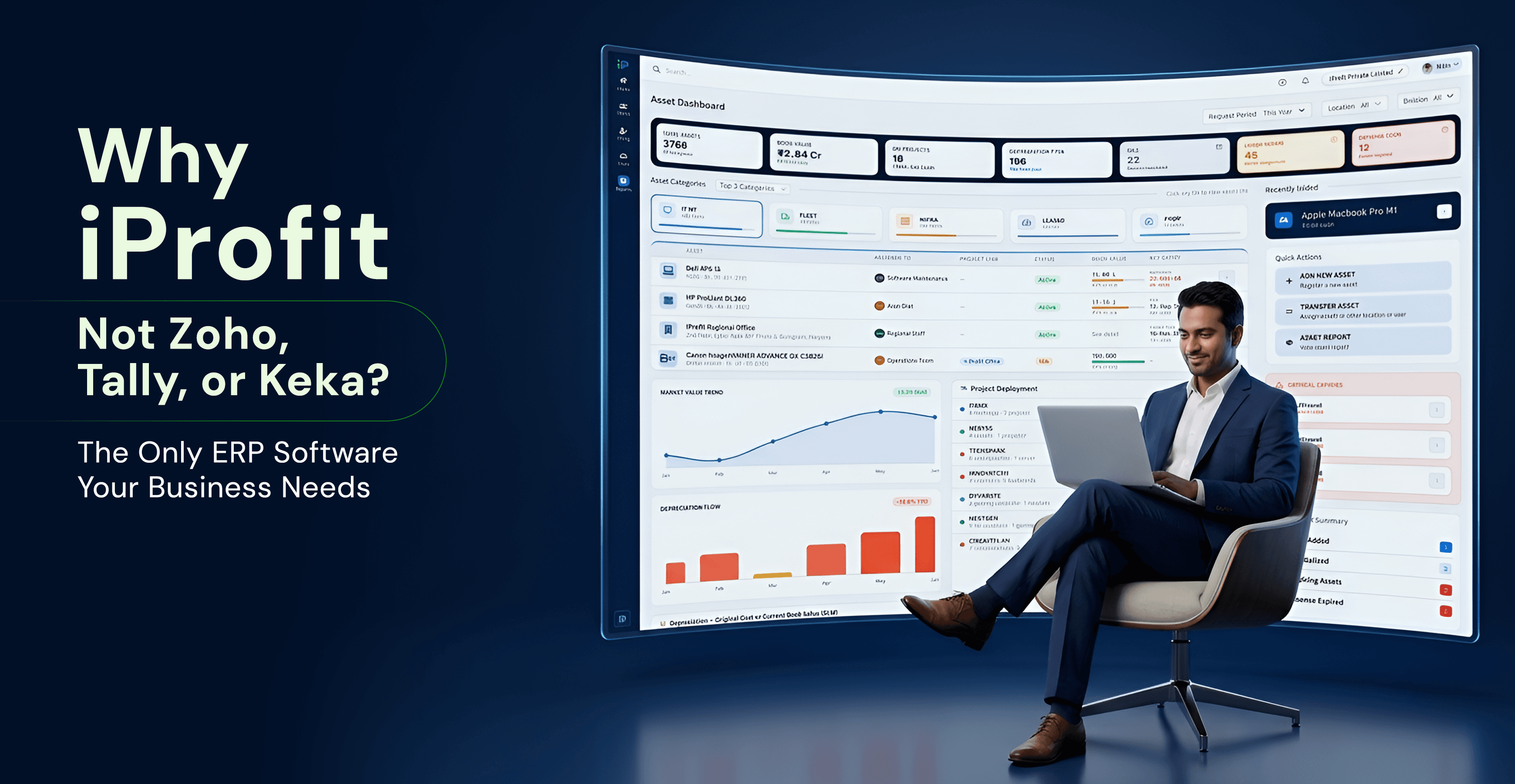
When growing businesses start evaluating an enterprise resource planning system, the comparison often doesn’t begin with, “Which ERP should we buy?”
It begins with a more familiar question:
“Can’t we just use Zoho for operations, Tally for accounts, and Keka for HRMS & payroll?”
On paper, it sounds practical. Pick a strong tool for each function, connect the basics, and move on. For many businesses, that feels like the lower-risk route.
This setup can work for a while. But as teams grow and operations become more layered, working across separate systems makes it harder to track the business with clarity and confidence.
That’s when the difference between using multiple tools and using a modern ERP software platform becomes hard to ignore.
At iProfit, we’ve seen this comparison play out across growing businesses that are trying to bring finance, HRMS & payroll, projects, and operations into one connected system.
And the real question is not whether Zoho, Tally, or Keka are good products. The real question is this:
Do you want to manage your business through multiple software products or run it through one connected system?
The hidden cost of using Zoho, Tally, & Keka together
You need a CRM or small business tool, so Zoho enters the picture. You need accounting and compliance familiarity, so Tally stays. You need HRMS and payroll, so Keka gets added.
Individually, each tool solves a department-level problem. But together, they often create a business-level challenge.
Because now your organization is split across systems:
- Employee records sit in one place
- Payroll data sits in another
- Finance entries live elsewhere
- Project or operational workflows are managed separately
- Reports are pulled manually or reconciled across platforms
This is where leadership teams start feeling the friction.
The problem is not that Zoho, Tally, or Keka are bad tools. It’s that as your business grows, managing key functions across separate platforms becomes harder, slower, and more dependent on manual coordination.
Instead of running everything through one connected system, your teams end up moving data and updates from one platform to another:
- HRMS & payroll to finance
- Project billing to accounts
- Asset allocation to employees
And every time work moves between tools, it adds another chance for delays, missed updates, or reporting errors.
The difference between buying software and buying operational clarity
The biggest shift businesses make when they move to ERP software is not just replacing multiple tools. It’s replacing fragmented workflows with connected decision-making.
When your finance team closes books in one system, HR runs payroll in another, and operations tracks delivery elsewhere, reporting becomes reactive. Teams spend time validating numbers before they can act on them.
An ERP changes that model.
Instead of asking, “Has this been updated?” your teams work on a shared platform where finance, HRMS, projects, inventory or assets, approvals, and reporting are part of the same operational flow.
That means fewer sync gaps, fewer manual interventions, and fewer “final-final” spreadsheets being circulated before every review meeting.
Why businesses outgrow the Zoho, Tally, & Keka combination
There’s a reason this comparison shows up in the minds of growing companies.
A multi-tool setup can work in the early stages, especially when teams are small and processes are still manageable through people. But growth changes the equation.
Once the organization becomes more process-heavy, three cracks begin to show.
1. Reporting becomes slower than the business
Leaders don’t just need data. They need connected data.
- Payroll costs against projects
- Department-level profitability
- Employee allocation and asset tracking
- Receivables, expenses, and project performance in one view
- Operational bottlenecks without waiting for three teams to send separate reports
When information sits across disconnected tools, reporting becomes a monthly exercise in assembling context. By the time the report is ready, the business has already moved.
2. Teams start working around the software
This is one of the clearest signs that the tools are no longer enough.
When employees start maintaining side spreadsheets, duplicating approvals over email, manually re-entering payroll or finance data, or depending on one “system expert” to stitch reports together, the process is already broken.
The tools may still be running. The workflow is not.
3. Accountability gets blurred across systems
When your business runs on separate tools, it becomes harder to answer simple operational questions:
- Which version of employee data is the latest?
- Was that reimbursement reflected in payroll and finance?
- Has the project billing been reconciled correctly?
- Who approved this asset allocation?
When the answer depends on checking three tools and two spreadsheets, the problem isn’t user discipline. The problem is system design.
So where does iProfit fit in?
iProfit is built for businesses that no longer want to operate through disconnected software.
It brings your core business functions into one ERP software platform, so your teams can work from one system instead of coordinating between many.
Instead of managing separate tools for CRM, projects, HRMS & payroll, assets, finance, and inventory, iProfit helps you connect those functions inside a single business environment.
That changes the way work moves.
A new employee joining the organization should not trigger disconnected updates across HRMS & payroll and asset records. A project shouldn’t need separate tracking in one tool and financial reconciliation in another.
Leadership shouldn’t need to wait for stitched-together reports to understand what’s happening in the business.
With iProfit, the goal is simple: one platform to run, manage, and grow your organization.
Why iProfit can make more sense than relying on multiple tools
One system instead of multiple software dependencies
When your business runs on separate tools, every integration, export, approval chain, and reconciliation becomes another dependency to manage.
With iProfit, the focus shifts from connecting software to connecting business processes.
Better visibility across functions
A business does not operate in silos. HR decisions affect payroll. Payroll affects finance. Projects affect billing. Assets affect employee operations. Leadership needs visibility across all of it.
ERP software should help you see the business as one connected unit, not as separate departments with separate dashboards.
Less manual work, fewer reconciliation gaps
The more tools you add, the more operational effort goes into keeping those tools aligned.
That effort is rarely visible during software demos, but it shows up every day in exports, follow-ups, duplicate entries, approval delays, and reporting corrections.
A platform designed for operational scale
The question is not whether multiple tools can work today. It’s whether they can support the business as it grows.
If your organization is growing in headcount, complexity, locations, projects, clients, or compliance needs, the cost of disconnected systems compounds fast.
An ERP software platform is not just a replacement for multiple tools. It is a way to reduce operational drag before it slows growth.
The real comparison: multiple tools vs. one ERP system
If your team is still small, your workflows are simple, and reporting needs are limited, a multi-tool setup may feel manageable.
But if your business is growing and your teams are spending more time coordinating between systems than moving work forward, the question is no longer “Which tools should we add next?”
“What would change if the business ran on one system instead?”
That is the comparison your leadership team is already making in their heads.
And that is why businesses evaluating ERP software eventually look beyond Zoho, Tally, & Keka and start looking at iProfit.
Because at a certain stage, growth does not need more tools. It needs one connected platform that helps the entire organization move together.
If your business is starting to feel the limits of managing multiple tools, iProfit gives you a simpler way to run, manage, and scale with clarity.
Ready to see what that looks like for your business? Book a demo with iProfit.